There was a seemingly small, but actually big moment in honors physics today. We putting our newly-developed model of universal gravitation through its paces, and started by looking at the Sun-Earth system. After listing all of the stuff that we knew about the system (discussing fusion vs. combustion a bit, too), making a conscious decision to model the Earth's orbit as circular, and asking what we could figure out next, we decided to determine the Earth-Sun distance, given the Sun's mass. It went the other way historically, I think, but this was good for our purposes.
The free-body diagrams started, followed by Fnets, and - before long - came the question/confused utterance (from a few sources in each section):
"There's a force acting on the Sun... ...and only one... ...but isn't it sitting still?"
The discussion afterwards about Newton's 2nd, approximations, etc. that got the problem train a'rolling is much less interesting than the train of thought that led to the question.
I made a big deal of it, because it was a big deal. There was confusion because worlds were colliding - students have "known" for most of their lives that the Sun sits still and the Earth orbits it. They have only recently begun to wrestle with the realities of Newton's laws, and, despite our best intentions and efforts, students can keep those two worlds mostly separate, mentally. There's the "real world" and the "physics class world." This is exactly what Eric Mazur is talking about.
Today, though, the confusion indicated that the two understandings weren't separate - they were both in there, trying to edge each other out of the ol' brain pan. Having a gut reaction like that, seeing that it doesn't make sense for a single force to be acting on an object if that object's not accelerating, and not being willing/able to just push the "physics class understanding" to the side is exactly what my goal is for my students.
What a great present for a Wednesday!
Wednesday, January 25, 2012


More software advice...
I got such a great response last time I asked for a referral to graph-creation software (yeah OmniGraphSketcher!), that I thought that I'd throw out another request.
Does anyone have a good piece of software for storing and sorting test/quiz/assessment questions and assembling them into finished printable assessments? I'd definitely need something that has easy image support, and an efficient way to organize all of the questions by topic/level/etc. Something that allows editing of the text parts would also be helpful. If it could store solutions as well, even better. I'm assuming that I'll put my standard rubrics in as questions that I can group on the last page, but a more native support would be awesome too. Oh, and I like to put graph paper behind each question.
That's not too much to ask, is it? :)
Thursday, January 19, 2012
A Great Thursday Morning: Time with Eric Mazur
Today I traveled to Malvern Prep School to attend a workshop on technology in education with physics ed superstar Eric Mazur.
If you haven't seen this - whether you're a student or teacher - I'd certainly advise that you watch - even the first 20 minutes gets you the idea:
I'll record some of the content and reflections on it, mostly for my own benefit!
If you haven't seen this - whether you're a student or teacher - I'd certainly advise that you watch - even the first 20 minutes gets you the idea:
I'll record some of the content and reflections on it, mostly for my own benefit!
- He's using a web applet that his company developed, mostly for word clouds (so far). There are valid criticisms of word clouds, but the first big idea is about learning through doing, not through being told. Check. We also have some mini-clickers that we'll be using later. They seem to have all of the capabilities of the first-generation Senteo/SmartResponse clickers. They're branded "Response Card." They're smaller and look cheaper, but their webiste doesn't give prices. Perhaps a more cost-effective way to clickify a larger school?
- It looks like we're getting a recap of the deprecation of "sage on the stage" teaching (direct instruction, lecture, etc.) from the famous video above. It's like going to a concert - I'm comparing the little deviations from the recording I've seen so many times! :) He must have said this sooooo many times. All good points, for sure.
- I also love that his spiel includes a discussion about how evaluation results from students are generally not correlated with how much students have learned. Instead, high marks are usually associated with ease of the class, average grades, or how much they "like" the teacher. Here's what appears to be a good summary of some of these issues. I wasn't successful in finding the paper that I was looking for that showed that students that reported "liking" the teacher tended to rate the teacher highly on even objective matters like the teacher starting and ending class on time, and vice versa.
- It only took 19 minutes for the "flipped classroom" to be brought up. I have some axes to grind there. How'd we get to the point where learning on your own outside the class is the "flipped" way? I seem to remember being held responsible for learning at least the basics of the material before class, with class being for application, extension, and higher-level connections. Still not a bad concept.
- I sum it up like this (it's something that I try to keep in mind always): lecture is about the transfer of information, but "active engagement" (modeling, inquiry, peer instruction, whatever your route is) is about the construction of understanding.
- About 20 minutes into the recap of "Confessions," I'm ready for some new material (it's really really important material - watch "Confessions" if you haven't! It's just that I have seen it two dozen times. :).
- Learning certainly is about being able to use that understanding in a new context. That's why you always get problems that are totally new to you on those pesky physics tests!
- 29 minutes in - now we're talking about the FCI. Uh oh, no new material coming for next next 15 minutes, I'll wager.
- Wow - that's a Father Guido Sarducci clip. Nice.
- Now we're into Peer Instruction - 44 minutes in.
- I wish that it weren't such a pain to write new clicker questions. The questions aren't as much the hassle as using Notebook software is. I have not found Notebook to be robust enough or quick enough to use to supplant OneNote and other software that I use in class. Maybe I'll devote the summer to increasing my cache of clicker questions.
- He's absolutely right that it's painful to give up your well-designed lectures and the thrill of a slick derivation on the board. To do so in exchange for students (initially, at least) being less enamored of your teaching is even worse. To see increased understanding on the FCI and other tests makes up for it.
- Peer instruction demo: 10 seconds lecture on thermal expansion, followed by the hole-in-the-plate problem [I saw that one coming!]. We answered using his Learning Catalytics web software, discussed, and people could change their answers. 23% initially correct, 33% after discussion. Well, pobody's nerfect. PI definitely depends on a higher proportion of initially correct answers than 23%. You're supposed to pair yourself with someone with a different answer. Not all of those will result in conversion of an incorrect answer to a correct one, and many folks out there were missing someone with a correct answer. He did a good job of stressing that the mental model is the important part, and the answer is secondary - if you're not keeping in mind the overriding condition that the metal atoms all push away from each other when the metal's heated, but try to generalize surface observations, you're toast on this one. I wish that I'd been a part of a conversation (or listened to one) between novices here.
- Interesting that he just pointed folks to his "Confessions" on Youtube. They'll find it familiar!
- 75 minutes in: Peer Instruction 2.0.
- He's looking at features of his site (a bit of a commercial, really), and how they're improvements on traditional clickers. One helpful bit is that they can be used with any device, and don't require the capital investment of clickers. The big issue for me is how the responses are collated and presented, so that you can make some sense of the answers in the moment. Without that, it would be pretty weak.
- Long answer, short answer, etc. - semantic analysis is mentioned, but he doesn't go into much depth. All I really see is the word cloud tangibly at this point, which isn't super useful for me in particular.
- There's a neat vector-drawing capability - you can put up a drawing and ask students to draw a direction, and then see all of the responses collated very quickly on top of each other. Nice feature - I like this one.
- Graph sketching works like this, too. Awesome.
- Text can be highlighted (highlit?), too, with a "heat map" of what students identified as important.
- You can select a region on an image, too
- You can key the input devices at the beginning of the session to where they're sitting in the room - where are the right/wrong answers coming from? The system can also track those trends historically. If one student has correct answers, but keeps being dissuaded or keeps not being able to persuade his/her partner, then you can track that. That's great, but tracking seems like more work than almost anybody has time to do.
- Overall, the system seems to have a lot of promise. It's still in beta, so it's free for now. Who knows what it'll cost when they start charging for it, though? I'd guess that it'd be much less than buying even one set of clickers.
- After a bagel break, we're back. Me: 2, bagels: 0 for the day.
- From some of the questions submitted to Mazur during the break, it looks like all of that time spent on interactive engagement and the failure of lecture in the first half didn't get everyone on board: "How do you balance time between the peer instruction discussion and covering material?" That presupposes exactly the normal lecture paradigm and that students learn what the teacher says - they learn what they construct for themselves, instead. Me rushing through a few more things doesn't mean that they learn a few more things, only that I've said a few more things. His results show increased performance even on problem-solving when using PI, even though they don't do any problem-solving in class! This isn't an addition - it's a substitution (at least a partial one) for the lecture/problem-solving paradigm.
- Now we're back into more on Peer Instruction. I like that he's being explicit about using data from students (clickers, etc.) to shape how the class evolves. He's also talking about 30-70% initially correct being a 'sweet spot' for PI, but having plans for the other cases!
- PI Trial #2: some buoyancy questions - rock in a boat, then remove the rock - what happens to the water level?; also rock in a boat, then rock goes to the bottom of the pool - what happens to the water level? [I thought that it would be the box at the bottom of the pool question, which is also great] The starting percentage for the first was more in the wheelhouse for PI, but the second went only from 17% to around 35%, similar to the first. There wasn't much instruction before or during, so it's no big deal, but Mazur did report that "physics instructors average around 30% on the first time," which seems to me to be at least as big of a problem as what we're doing pedagogically. How does our system let you get to be a physics teacher while missing lots of fundamental conceptual understanding? (It's not just this question that I'm reacting to - I've heard this type of setup a lot, mostly as an argument about how important it is for us to teach conceptual understanding.) It's a rhetorical question - certainly there are many factors that press folks into service as physics teachers against their training, etc., but getting successfully through a physics degree program without wide-ranging conceptual understanding ought to be not possible.
- PI Trial #3: this one was more in the ethics arena (about retouching photos and how much is too much), with Mazur demonstrating how PI can be used in non-technical fields as a framer and catalyst of discussion (I suppose that's why Mazur calls his company Learning Catalytics).
- He has only addressed a couple of the audience-submitted questions, but promises that his post-docs will answer them all and email them to us. That should be an interesting document; I'll add it to the post when I receive it, or make a new post, depending on the time delay.
- His presentation of results is a good model - he shows the axes first, discusses what they mean and what information is being presented in what way, and then adds the data. That's a great way to present graphs.
- A bit now about non-tech methods to do the same polling (fingers against the chest here) - the key's the engagement, not the tech that makes it happen.
- Ending with a bit about resistance from students - the initial drop in performance/confidence upon changing methods. This is very similar to my post about the transition from unconscious incompetence to conscious incompetence, which is unfortunately the only way to get to any level of competence. This is a big one. You have to stick to your guns, and acculturate students towards the idea that making mistakes is the most important part of learning - they're not to be feared! We have to run towards the gunfire. For teachers, that also means the much less fun gunfire from students and parents when they see something new, when they have difficulty for the first time (because they're reasoning much more heavily for the first time), when their grades have no "fluff" to boost them to compensate for lack of understanding, etc. Hold the line - it's only about learning. Learning can be measured. That evidence is what you can use to confront these concerns (and the only thing that really verifies whether what you're doing is working, no matter what you're doing!), but you have to personally argue and really believe that you can change how somebody thinks about learning and how well they can learn.
- While talking for a while in the lobby afterward, we were the only two left and then got a little chat with Mazur and a handshake! :)
Wednesday, January 4, 2012
Congratulations Alex!
Alex Christofferson made a video of his "Physics of Osmos" capstone project results to submit to the Physics of Osmos Contest, hosted by Hemisphere Games and featuring a $500 Amazon gift card for the winner.
He did a great job analyzing the conservation (and non-conservation) of momentum in the game, and of finding out that the mass of the motes is depicted by their area (rather then by their volume or length).
For his excellent work, Alex has won first prize in the competition! Great job, Alex!
He did a great job analyzing the conservation (and non-conservation) of momentum in the game, and of finding out that the mass of the motes is depicted by their area (rather then by their volume or length).
For his excellent work, Alex has won first prize in the competition! Great job, Alex!
Saturday, December 17, 2011
Quick Labs: AP Physics/Energy
The AP Physics class did a bang-up job on some quick labs about energy on Friday - just a mere 3 days before winter break! All three projects showed terrific use of revision of their prototype experiments, as well.
The premise of the quick lab is to design, carry out, analyze, and present an experiment during a single 90-minute class period. Presentations should be a single whiteboard.
The experiments:
Alex, Alex, Brandon


Kawala and Kati


Cam, Mike, and Toru:
The premise of the quick lab is to design, carry out, analyze, and present an experiment during a single 90-minute class period. Presentations should be a single whiteboard.
The experiments:
Alex, Alex, Brandon
- They took video of basketball shots, from launch to floor, and used video analysis to determine how much energy the net (all were 'swishes,' of course) took from the ball as it went through.
- Revisions: initially using the first two points of the video to determine the launch velocity gave unrealistically high results, so they changed that part of the analysis to use kinematics to analyze the change in horizontal and vertical position and time taken (all easily measured from the video) from launch to goal in order to find the launch velocity.
- The boards (yes, they cheated and used two!):


Kawala and Kati
- They slid a small whiteboard eraser down a ramp, after which it plunged to the floor. To determine the coefficient of kinetic friction between the ramp and the block, they used the fall distance and how far away the eraser landed from the table, along with the ramp length and angle. This required marrying kinematics, conservation of energy, and the work-energy theorem, and 2.5 gallons of algebra.
- Revisions: they used two different 'floors' to take data, having the eraser hit the actual floor in one trial and hit a crate sitting on the floor in another trial. The advantage of this is that we can find errors by looking at the trend in the data as the height of the floor is varied. This is a great check that nothing unexpected is going on, and it was a good thing, because the first value was reasonable, but there were a few little errors to be uncovered. The coefficients came out negative when the height was changed, so it gave a prompt to find the issues, and now they're confident in these numbers!
- The boards (also two!):


Cam, Mike, and Toru:
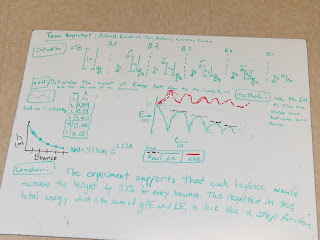
- These guys took some high-speed video as well, analyzing the heights of a bouncing ping-pong ball. In addition to modeling the height of the ball as a function of bounce (and making a slick argument that the exponential function implies a constant-percentage loss of energy (rather than a constant amount of energy lost), they used Logger Pro to graph the gravitational PE, kinetic energy, and total energy as a function of time, showing the expected constant total energy during each flight (well, a slight decline due to air resistance), with "steps down" in total energy following each bounce.
- Revisions: after considering the parallax issue with measuring the height of the bouncing ball moving in front of a meter stick (especially with the camera mounted to a tripod), they instead dropped the ball next to the meter stick, eliminating the point-of-view issue.
- The board:

Tuesday, December 13, 2011
Why We Run Towards the Gunfire
We had some scheduling issues last week in physics with visitors, so I made an in-class assessment a take-home assessment. One great thing about SBG is that there's really no point to cheating on such an assessment, so I think that I'm still getting a good picture of where they are.
On this question, they were (in general) in the weeds:
On this question, they were (in general) in the weeds:
" Two radio towers 30 km apart transmit synchronized 240 kHz signals. If a car equipped with a radio receiver tuned to the transmission frequency drives directly from one tower to the other, what will the receiver hear? Explain; a diagram would help! Radio signals are light waves that travel 300,000,000 meters per second.
What would the signal be like at a point along the drive that is 8750 meters from the first tower
How would the driving experience change if the radios’ frequencies were changed to 300 kHz?"
We've done some work with 2-source interference, from looking at the "overlapping ripples" diagrams to doing some predictions of frequency from two interfering sound waves given the locations of some points of constructive and destructive interference in the room.
This is the same concept, but a different-looking context, and that's where kids that haven't quite figured out the whole axiomatic reasoning thing have difficulty - yes it looks different, but we can still use the same principles to make predictions about what happens.
In particular, the big message for 2-source interference is that, even though both waves start in phase, they may not be in phase when they reach you, if you're different distances from the two sources. The difference in travel distance determines the phases of the waves and whether they'll interfere constructively or destructively. [This type of relationship is familiar: rates (relatives of differences) are famously difficult for students to intuitively grasp - see calculus!]
Back to the story, though:
I collected the assessments at the beginning of class and then posted this problem via projector. I set the online stopwatch to five minutes and told them to come up with something coherent in their whiteboarding groups. There was a good discussion after that, and we made a lot of good connections.
...before that, though, there was an audible groan when I posted the problem.
Why? It's a hard problem! They've already wrestled with it for some period of time, felt anxiety that they were adrift about (da-dum!) an assessment problem, and here I was bringing it up again.
Here's the thing, though: you don't learn anything by running away from those difficult problems - you have to figure them out so that you can use that understanding in the future. Denial is death in problem-solving.
Soldiers and police officers are incredible because they run towards gunfire, while the rest of us run away. There's an anxiety-filled and dangerous situation, but they do the harder thing and confront it directly.
In physics (or learning in general), we have to run towards the gunfire too - you have to seek out and fix those misconceptions and misunderstandings. It's anxiety-filled, too, but one student yesterday noticed a crucial difference between the two situations, when SBG is used: for us, the wounds aren't permanent.
Not Proficient? No problem - wrestle with the problem, come back, and then you'll be whole again. Using traditional grading that students are accustomed to, I totally understand why they get gunshy, even at the level of course selection. Reminding them that this is a safer space for making mistakes has to be a constant occurrence because of that ingrained anxiety, but it's well worth the effort.
Wednesday, December 7, 2011
One of my favorite demos
I love the demonstration of two-source interference of sound waves - two speakers and a sine wave generator is all it takes to get one of those moments that kids remember for a long while after the course is over (now, if we can just get them to remember why it happens!).
The echoes in my lab aren't too bad, and we can actually map an interference pattern reasonably well, in large areas. At some point, I'd like to try this in a big space and have them mark nodes (quiet points) and antinodes (loud points) with cones or something, and see if we can recreate the classic illustration.

In the meantime, we mapped out a few points that were relatively easily found:

At this point, we already knew all about order lines and how these loud and soft points came to be; we had analyzed a diagram of the interfering waves, determined where constructive and destructive interference were happening, and noticed the pattern in the 'lines' of nodes and antinodes (and even brought those shapes back to the base definition of a hyperbola!).
This was their first chance to apply that to a live problem: what's the frequency of that annoying hum that I'm playing through the speakers, anyway? Are these measurements all that we need to determine that? After all, there's nothing about time here at all, so determining the frequency seems daunting at first.
"What order line is that first soft point on?" is the real catalyzing question that I ask the groups a few minutes into their whiteboarding, if they haven't figured out how to apply the two-source model yet.
From there, there are a few steps of reasoning, some triangle manipulation, and some unit conversions needed. The triangles and unit conversions shouldn't be an issue at this point, though they still are for some that haven't reached an unconscious competence level. These assumed skills can really derail you. Especially if a problem is already difficult enough to tax your faculties to the max to begin with, adding a protracted wrestle with a unit conversion or diagramming effectively is likely to push your brain into a useless fried state (like okra).
Once we've connected that the order number is important, that connects to something about the distances from the speakers to the point, so we need to find those distances, using the Pythagorean theorem:

OK, great, but what does the order number tell us? This is a place where the sound is quiet because there's destructive interference, which happens because the waves travel different distances to get here. The waves began synchronized, but since they've traveled different distances, they're at different points in their oscillation between high and low pressure (they're out of phase). At this place, the wave from the left speaker has traveled half of a wavelength further than the wave from the right speaker (that's the .5 in the order number!). Now we know two different ways to write the difference in travel distances:

 Now that we know the wavelength, we're all set:
 That's quiet a chain of thought there - let's trace the inferences that you have to make to solve this problem:

That's quite a set of inferences and observations, each necessary to solve the problem. This number of inferences and observations is necessary for many problems that students try to solve, but we don't often think about the chain of logic so literally. A great deal goes on behind the scenes... or doesn't. Note too that there's knowledge from previous courses, previous terms and units of this course, and the current situation, but that it all has to fit together; this doesn't happen if students view understanding as disposable. That sort of mindset is like tying your leg to a tree and trying to go for a run - no matter what direction you go, you can only go so far.
I think that, if students can get comfortable spelling out their reasoning like this, then they can get better at making a linear argument, which is what all problem-solving is - each step must be supported by knowledge or information and must lead to the next step. Scatter-shot thinking is rampant, and it does not help problem-solving. Perhaps conscious effort on constructing a "chain of reasoning" can help a student be able to do this type of thinking unconsciously, too!
The echoes in my lab aren't too bad, and we can actually map an interference pattern reasonably well, in large areas. At some point, I'd like to try this in a big space and have them mark nodes (quiet points) and antinodes (loud points) with cones or something, and see if we can recreate the classic illustration.

In the meantime, we mapped out a few points that were relatively easily found:

At this point, we already knew all about order lines and how these loud and soft points came to be; we had analyzed a diagram of the interfering waves, determined where constructive and destructive interference were happening, and noticed the pattern in the 'lines' of nodes and antinodes (and even brought those shapes back to the base definition of a hyperbola!).
This was their first chance to apply that to a live problem: what's the frequency of that annoying hum that I'm playing through the speakers, anyway? Are these measurements all that we need to determine that? After all, there's nothing about time here at all, so determining the frequency seems daunting at first.
"What order line is that first soft point on?" is the real catalyzing question that I ask the groups a few minutes into their whiteboarding, if they haven't figured out how to apply the two-source model yet.
From there, there are a few steps of reasoning, some triangle manipulation, and some unit conversions needed. The triangles and unit conversions shouldn't be an issue at this point, though they still are for some that haven't reached an unconscious competence level. These assumed skills can really derail you. Especially if a problem is already difficult enough to tax your faculties to the max to begin with, adding a protracted wrestle with a unit conversion or diagramming effectively is likely to push your brain into a useless fried state (like okra).
Once we've connected that the order number is important, that connects to something about the distances from the speakers to the point, so we need to find those distances, using the Pythagorean theorem:

OK, great, but what does the order number tell us? This is a place where the sound is quiet because there's destructive interference, which happens because the waves travel different distances to get here. The waves began synchronized, but since they've traveled different distances, they're at different points in their oscillation between high and low pressure (they're out of phase). At this place, the wave from the left speaker has traveled half of a wavelength further than the wave from the right speaker (that's the .5 in the order number!). Now we know two different ways to write the difference in travel distances:
That's quite a set of inferences and observations, each necessary to solve the problem. This number of inferences and observations is necessary for many problems that students try to solve, but we don't often think about the chain of logic so literally. A great deal goes on behind the scenes... or doesn't. Note too that there's knowledge from previous courses, previous terms and units of this course, and the current situation, but that it all has to fit together; this doesn't happen if students view understanding as disposable. That sort of mindset is like tying your leg to a tree and trying to go for a run - no matter what direction you go, you can only go so far.
I think that, if students can get comfortable spelling out their reasoning like this, then they can get better at making a linear argument, which is what all problem-solving is - each step must be supported by knowledge or information and must lead to the next step. Scatter-shot thinking is rampant, and it does not help problem-solving. Perhaps conscious effort on constructing a "chain of reasoning" can help a student be able to do this type of thinking unconsciously, too!
Subscribe to:
Posts (Atom)