Thursday, September 26, 2013

Drag Graphs and Terminal Velocity

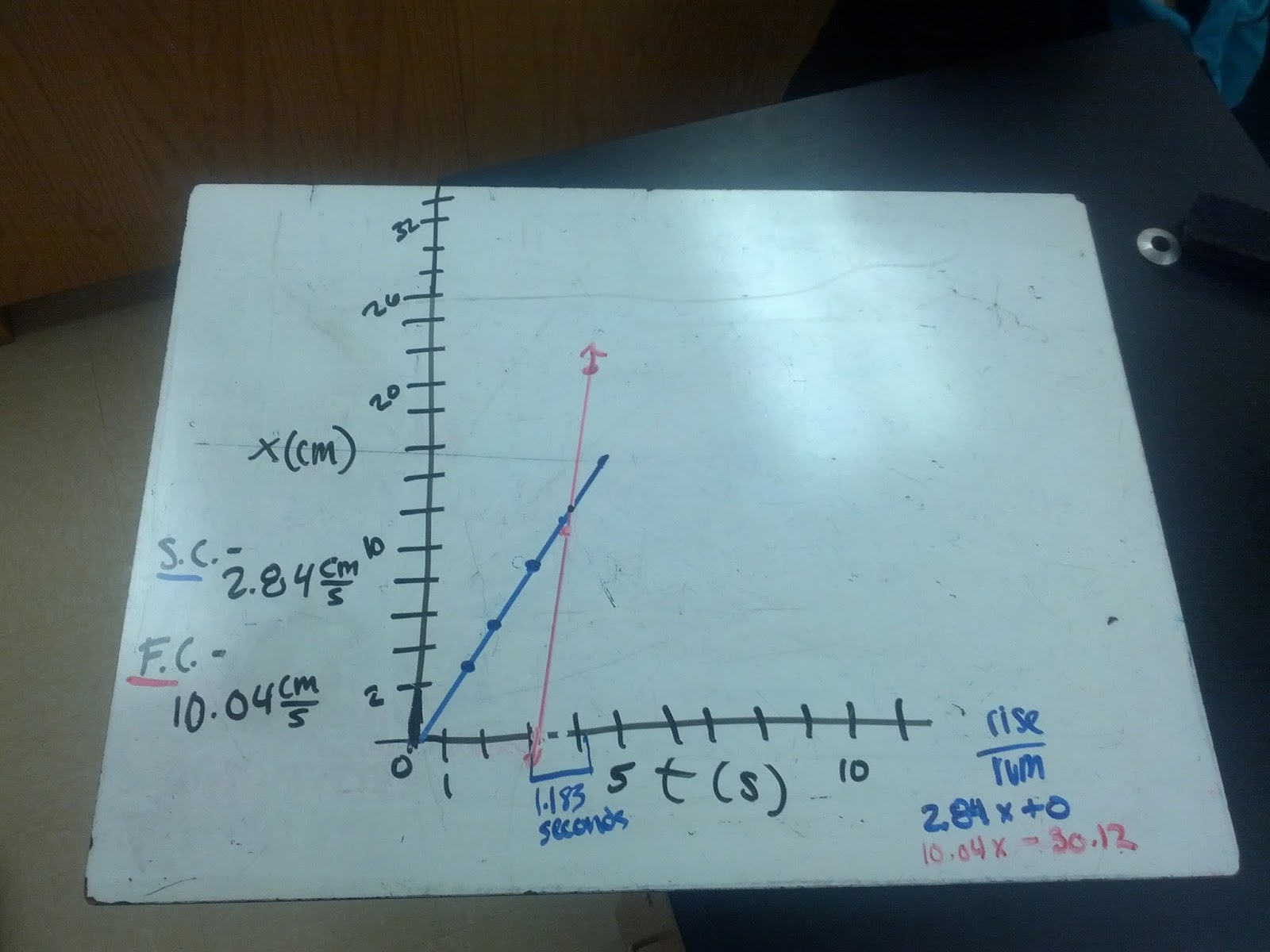
This summer, I posted my progression on drag here. One of the new elements was a pair activity where students each calculate the terminal speed of some random object that they come up with and draw (on the same set of axes) the position, velocity, and acceleration curves for the two objects. I then put the values into a VPython script and we check.

We did that today, for the first time, and it went pretty well. The students picked an iPad vs. a calculator and a big (1m on a side) metal box vs. a 747 (nose first). Here's what they got:
iPad (red), calculator (blue)

Neat that the heavier iPad had a lower terminal speed - it's much bigger!

747 (red), box (blue)

That 747 didn't even come close to getting to its terminal speed from 400 meters: how about from 10,000 meters?
747(red), box (blue)

Not much better there. It took nearly 300 km of fall to get there - very heavy, very low drag coefficient.

It was a bit unwieldy entering the values during class, so I think that I might do a Google form/Googlecl/VPython solution to pull those values in from the cloud next year.

Monday, September 16, 2013

A Two-pulley Practicum

In the AP C: Mechanics course, we're working through some extensions to old models - non-constant acceleration as a more general application of CAPM principles, UFPM with non-constant forces, etc.

Even with constant acceleration and constant forces, there are some more subtle, but very powerful, techniques that we can't do the first time around. The first is the "look at the whole system" approach to force analysis. Instead of analyzing the half-Atwood machine, for example, as a hanging mass and a cart, and eliminating the tension algebraically, we decide that the net force accelerating the system is mg and the total mass of the system is m+M, and it's super easy to get the system's acceleration. I know that some folks do this in the first year, but I like having them draw those two FBDs and really puzzle out how the force sizes relate to each other, and I think that this is just a little too black-box (especially with the change in direction of the motion in the middle) for the first year. It's also really good algebra practice.

We'll do that today, but we'll also take a look at this situation:
This can be really tricky to analyze as either a separate or a combined system, but we can make an observation about the rope that's really helpful. When the cart moves a distance d to the right, the rope's downward motion is complicated by the presence of the pulley, but a little careful diagramming can show that half of that d will end up as a longer right-hand vertical rope, and half will end up as a longer left-hand vertical rope, so that the hanging mass m will only drop d/2. Using that, the acceleration of the hanging mass must be half of the acceleration of the cart, which allows us to really easily solve for the unknown acceleration.


This worked out very well as a practicum for me, using Pasco track, carts, and superpulleys (with 100g clamped into the jaws of the hanging one. The time's long enough (with a cart run of about a meter) to be timed pretty well with a stopwatch.
I think that this does a great job of emphasizing the importance of thinking during the problem-solving process and of adding a new twist to what students might think is a "completed" topic.


Friday, September 13, 2013

Follow-up to the Buggy Lab

In a post yesterday, I shared a new piece of my (WCYDWT) buggy lab: having students mark explicitly on the graph which interval denotes their "answer," and having the other groups interpret the graph to determine what the situation and question were.

I had really only done this with one of two sections of Physics, and I have now had both of those sections a second time after that lab. The results for one task seemed pretty clear. I used Matt Greenwolfe's suggestion here to wrap that up by asking them to draw a specific position vs. time graph for all six robots. I actually asked for two graphs: first, for the six robots, if each was programmed to run for 20 seconds and stop (that's how they were actually programmed on the first day). Second, for the six robots, if each was programmed to run for one meter and stop.

The first class had some of the same issues that Matt described: confusing the time and distance intervals, ascribing meaning to the length of the line, etc. After some discussion, they figured it out and went on. The second class had a much higher proportion of correct graphs from the beginning on both questions. It was a large departure from previous classes' performance as well, so it seems to have had a positive effect.

One of the graphs from the second question is below. The others have been erased, but several of them drew dotted lines horizontally or vertically first, then drew their graphs, which is a great sign.


Wednesday, September 11, 2013

Standards for the Year

We had a great discussion on standards-based grading at the Global Physics Department tonight. Here are my standards for the year for each course, in response to a request from that conversation.

AP Physics:

  • Term 1 (Momentum Principle)
  • Term 2 (Energy Principle)
  • Term 3 (Angular Momentum Principle)
Honors Physics:
  • Term 1 (Motion, Forces)
  • Term 2 (UCM, Gravitation, momentum)
  • Term 3 (Energy, Oscillations, Static Electricity, DC Circuits)
Physics:
  • Term 1 (Motion, Forces)
  • Term 2 (Oscillations, Waves)
  • Term 3 (Sound, Phases/Eclipses/Shadows, Geometric Optics)

A New Twist on the Buggy Lab

I usually do the CVPM buggy lab as a WCYWDT? (What Can You Do With This?) challenge. Here's what that looks like:

  • Each group gets a slow and a fast cart (this year, I'm using the Scribbler 2 robots, along with Matt Greenwolfe's software)
  • Each group has to come up with a unique question - they put the carts into a situation and then make some prediction. Common ones include: "If they start a meter apart, where/when will they collide?" and "How much of a head start (time or distance) does the slow one need in order for the race to be a tie?"
  • Groups take data, using only one cart at a time (no testing before the big reveal!)
  • Groups create position vs. time graphs to answer their questions
  • Along the way, I ask some questions to be sure that they're framing speed correctly (m/s vs. s/m), that they're really representing their situation with the graph (if they don't start at the same place, then they shouldn't on the graph, either), etc.
  • They test their predictions, in front of everyone. These always go well, and I think that the inherent slowness of the Scribblers makes them more dramatic and easier to discern whether the test worked or not.
Here's the new part:
  • As they're finishing up their whiteboards, I have them bracket the answer to the question on their graph - if they're predicting a distance, then they need to show where that distance interval is located on the graph. If it's a time interval, then they need to bracket that, etc.
  • Students do not write their questions on the boards
  • The "presentation": students show their WBs, saying nothing. It's the rest of the class's job to figure out exactly what their situation was and what they were trying to find.
Here's why:
  • Some students have trouble differentiating between a fast car and a slow one and between a race and a head-on collision at this early stage. Having had to go through that process when they drew their graphs, they now get a few more chances to practice those skills immediately after that first experience.
  • Lots of students have difficulty locating different quantities on their graphs. In CVPM, it's not nearly as big a deal, but lots can go off of the rails when trying to find delta v or the final velocity or the displacement, etc. when we get to CAPM, so this is working on those skills early and explicitly.
  • It keeps the viewers actively engaged, much like the mistake game or other similar strategies.
Here are a few examples from today. I really like the fourth on, because the time interval that they were looking for was not starting at zero, but instead from when the second cart started. That's the sort of thing that often trips students up, even if they've drawn a correct graph to begin with.


Friday, August 30, 2013

Reasonable Numbers, Unreasonable Nutrition

I just went to a McDonald's to eat and use the wi-fi to get some work done. Here's how it went down:

  • Ordered 20 pc meal (stop with your judging eyes) 
  • Cashier kid heard 10 pc. I didn't notice until after I had paid. 
  • He called over manager. She decided to see what the price of the 20 pc meal was ($7.50), look at the receipt ($6.19), and charge the difference. 
  • She asked the kid what the difference was. He was pretty satisfied with his answer of $1.20. She found an item for $1.15 and charged me. 
  • Everyone involved was very nice and helpful, and works too hard for too little money.
There are a lot of failure modes for mental arithmetic, but there are some simple checks that you should go through. Here, anything that doesn't end with 1 is impossible. It's easy to come to $1.41 or maybe $1.21, but $1.20 shouldn't pass the smell test. 

We've been doing some curriculum work at school, and the math and science departments across all four divisions are convinced that this sort of answer-checking is something that kids have to have. They're right. It's a habit of mind for a scientist or mathematician, and it's something that we have to spend time with our kids on if we want them to learn it. 

$1.30 as an approximate answer's pretty good, and that's something else that we should work with kids on - coming to first approximations before solving a problem, so that we have some idea about what we're supposed to get, not falling prey to the "writing down whatever the calculator spits out" syndrome. These approximations can be about rounding numbers or about using a first-order Taylor series or squaring off a curve or whatever, but this is a skill that's even less frequently explicitly taught in schools than checking answers for reasonableness. Dan Meyer's "Give me a number that's too high, give me a number that's too low, give me a guess" is a great way to start.

There's certainly a lot of content to get through, but these mathematical practices are arguably at least as important, not least because they'll often survive after the content is forgotten. Don't we want to live in a world where people have these tools (even non-academic folk)? If the answer's yes, then put your class time and assessment questions where your mouth is this year - make time for work on reasonableness-checking and approximation.

Saturday, August 17, 2013

Whiteboard Loudly

I came across "University Buys Bulletproof Whiteboards" today. It's about a move by UM-Eastern Shore to buy 200 18"x20" bulletproof whiteboards - at what seems like a cost of $300 a piece. The idea is that students and teachers can use these as shields in the event of a school shooting. Those logistics aside, two things:

1. This is a far cry from the $2 Interactive Whiteboard! Portable whiteboards are cheap and can instantly transform a classroom into a place of doing, rather than a place of hearing. While it's great that some of these whiteboards are going into UMES, I hope that they're also being used to change the environment of the classroom, rather than sitting next to desks waiting for bad news. For the price, they could buy/make a $2 whiteboard for every student at the school! The cost/benefit analysis here isn't really my point, but if these are worth $60,000, maybe it's also worth it to spend $5000 to outfit every room in the school with a set of student whiteboards, and worth the cost to train teachers to use them effectively to increase student engagement and learning.

2. I generally try to stay away from the bottom half of the internet, but the comments in the CNN article speak volumes. Almost everybody there cannot conceive of whiteboards that are not the exclusive domain of the teacher. (some disturbing images ahead, and, as usual, even more offensive stuff in other comments on the article, so follow those at your own risk)
  • "Sure is a publicity stun[t]. Dumb one at that because it's pretty obvious that a shooter can figure out how to walk behind a white board."
  • "How does a bullet-proof white board, which is mounted against a wall, protect anyone from bullets, which would be fired from somewhere inside the same room?"
  • "The point derpmage is making is that all these whiteboards are mounted (i.e. screwed into the walls) typically in these classrooms. So, if something started, what is a teacher supposed to do? Are they supposed to somehow rip a bulletproof Kevlar Reinforced whiteboard off the wall somehow in order to use it to protect themselves and others? Not going to happen. A waste of taxpayer dollars."
  • "There's a hook for easy hanging. Did you honestly think that you were the only one smart enough to realize that having it bolted to the wall would be problematic? It may be a waste, but they did have the foresight to consider the access issue."
  • "Many whiteboards are used as standalones next to the blackboard... not hung on walls..."
  • "Most schools got away from blackboards and use large whiteboards attached to the walls and use markers. This is really too small for classrooms. It wouldn't hold much information. Besides, the teacher may be safe but not the students. One University building has more then 200 rooms."
  • "You take it off the wall and use it as a shield."
  • "Is the professor supposed to hold the whiteboard -all the time- in preparation for the moment a gunman comes charging through the door? Otherwise they'll be dead before they get to it."
  • "Also, I reckon these whiteboards may be more handy for a crazy gunman than the professor trying to hide behind it. Simply take out professor and ... BINGO, the gunman now has a shield against law enforcement to hold off their position! Super dumb in my opinion."
Even folks that notice the small sizes of the boards go through contortions to imagine them on the wall, in the professor's hand, etc. I haven't seen a single comment understand the idea that the whiteboards are for the students. If you're whiteboarding, don't keep it a secret! It's pretty infectious, so let some teachers see students working actively with whiteboards, figuring things out, collaborating, being skeptical... ; it got me hooked!

A few links about whiteboarding: