Monday, January 14, 2013

Pick a Fight!

Well, not really, but maybe a "physics fight"...

We had a friendly competition with a neighboring school today and Friday via Skype:
  • Each school checked out a clip of "Despicable Me" this week (about four minutes, dealing with the rocket trip to the moon, the shrinking of the moon, and the trip back) and was challenged to model, debunk, predict, verify, etc. whatever they could. My class spent 90 minutes on this, and I think that the other school did about the same. 
  • I didn't give them any help or direction, except for telling the name of some new concept that they wanted, so that they could effectively index/Google on their own (terminal velocity, energy-mass equivalence, and shear strength came up)
  • Each problem was whiteboarded, and we took pictures of the boards (some of theirs had nice electronic presentations, though). 
  • Today we Skyped and took turns: 10 minutes of presentation followed by 7 minutes of questions. 
It's not really a competition, but it's fun to frame it that way, since they're used to having long-standing rivalries in sports against local schools.

The investigations were fun, and it was great for the students to interact with each other from afar. We're also planning to trade some screencasts with intentional mistakes in them.

If you want to interject a little more fun into the WCYDWT?/whiteboarding/Mythbusting/modeling paradigm, maybe you should pick a 'fight' with a nearby school!

Here are our whiteboards, from both sections that participated:

An analysis of the speed of the spaceship (not surprisingly, too fast for reality), using the altitudes of different parts of the atmosphere for reference:

An analysis of the mass of the shrunken moon, assuming that its density stayed the same:

...using that mass, the freefall acceleration and very-low-orbit speed for the tiny moon:

Assuming that all of that missing mass was converted into energy, the ridiculously large amount that there would be:


An analysis of how the now-tiny moon would basically eliminate tides:


This class assumed that the moon's mass would stay the same, rather than its density. A proof that this would do nothing to the tides:

Assuming CAPM speeding up and slowing down, the acceleration of the spaceship and the resulting huge forces on Gru, if he is going to make it to the dance recital:


The freefall acceleration on the surface of the tiny moon:


Trying to determine Gru's speed when he hits the shrunken moon (it shrinks to be at its center of mass, so he's one moon-radius away, and then he freefalls towards it); CAPM is used, with the acknowledgment that it's not appropriate.

Assuming that he hits the moon and stops in a short distance (stomach compression), the huge normal force that would be exerted on him by the moon when he hits it:

A comparison of the pressure exerted by that huge force and the shear strength of bone, showing just how easily that moon would cut a hole straight through him (and then he'd continue past it, slowing down as he moves, then back again, in an oscillation with the moon passing through the same hole over and over... OK, physics isn't pretty).

Friday, January 11, 2013

Physics Jeopardy

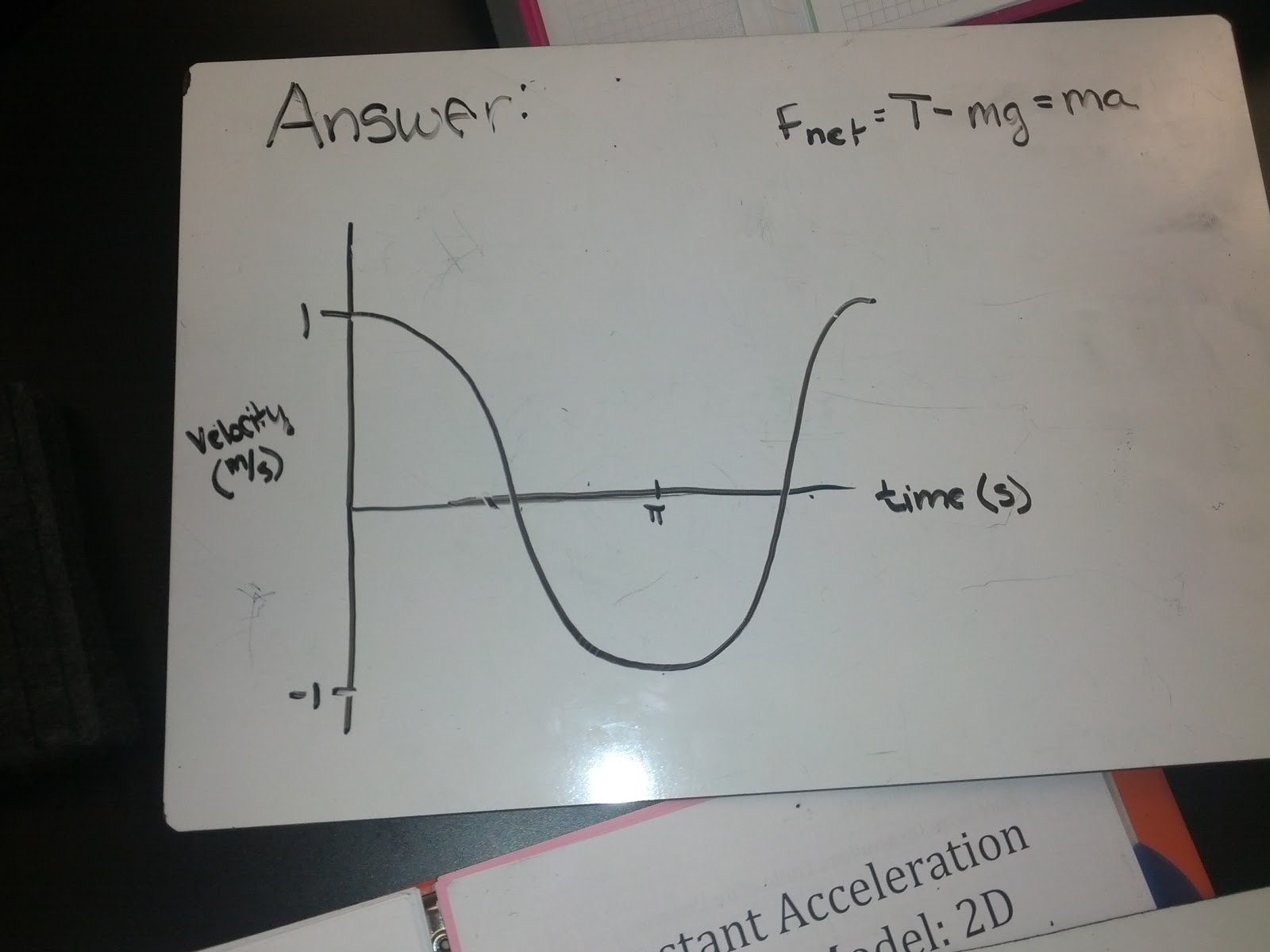
As part of a little mid-year reflection on the force and motion models that we've developed over the first third-ish of the year, Honors Physics students developed a series of Physics Jeopardy answers and questions.

Our format:

  • 'Answers' (the clues) are motion graphs or net force equations
  • 'Questions' (what the players are supposed to determine from the answers) are diagrams of the situation being modeled
The idea is to encourage a closer connection among three of the representations that are most common - diagrams, graphs, and equations. By going 'backwards,' students have a lot of detective work to do, which really makes them think about which physical statements or results are consequences of which models.

Here's our set of answers and questions:


Monday, December 31, 2012

Using Google Docs for Labs

I have a couple of labs that I have flipped the data collection process for, and done more of the analysis in class. There are advantages and disadvantages here:

Advantages:

  • Less time taken in class for data collection, more time for data analysis
  • Everyone gets to make the measurement, instead of some students sitting on the sidelines
  • More data possible, as we can bin the data sets for big group analysis
It's this last one that has the most impact on whether I do the data collection like this or not; if we need a lot of data, it's boring and cumbersome for each group to do it and not as easy to share as it should be within the classroom.

Some disadvantages:
  • The collection process has to be simple and cookbook enough for students to be able to do it independently, with essentially no equipment (simulations and videos are good)
  • There's not any tinkering with the setup or designing the experiment
  • It's not appropriate for introducing a completely new paradigm - not at all
  • Students can't/don't easily ask questions, so you can get some junk data if you're not careful with the design and instructions
With those caveats, there are some cases in which I've found it quite useful:

Experiment 1: Period Measurement Techniques
Students did the experiment here.

The goal was to look at the effects of different measurement techniques on the period value - not just the mean, but the width of the distribution. I use this to introduce the concept of distribution width, too.

I put columns into the Google spreadsheet to calculate the period for each method and then paste the data into Excel, where I graph the normal distribution derived from each data set and graph them on common axes:

There's not much choice about this one - you need a big data set, and this is the easiest way to collect and analyze it that I've come up with.

This requires some manual cutting/pasting, etc., but the next one's nice and automatic:

Experiment 2: Resonance
I'm doing this one during the upcoming unit; I haven't done it before, but I think that it's relatively foolproof.

Students did the experiment here, which uses an applet dealing with the amplitude of a driven string. We're getting at the idea that a system will respond with a big amplitude only when it's driven at or near one of its natural frequencies (the frequencies of the allowable standing waves, in this case). This is a great intro to musical instruments: the buzzing of a mouthpiece or reed isn't really producing a single pitch, but a wide spectrum of noise, of which only the instrument's natural frequencies resonate and are heard.

This one is much cleaner with the data analysis. I used Python and GoogleCL to download the Google doc data, sort it, and graph it automatically.

The code looks like this:

And the output looks like this (fake data that I used to test it):

I do these infrequently (about once per term), but it can be a big help. I also wouldn't do them in any sort of context that required big paradigm-building, etc. They're straightforward cases where I need a lot of data, where that data can be collected over the internet or at home, and where the experiment's straightforward enough and involves an established setup or concept that I can trust them to give me accurate data.


Tuesday, December 25, 2012

Sharing Whiteboards

What to do with student whiteboards? Pick a great one and share it with the school! Here's a display case that I had Operations build to show off whiteboards outside my room:

Some Capstones

A few capstones from the AP class in the first term. I wasn't super-happy with the management of these - not enough revision and discussion - but there were certainly some good ones in there. Here's a smattering of the final reports. Some include VPython programs which are pretty neat, too.

  • A capstone where a student writes a VPython program to prove that the freefall time for any tunnel through the Earth (along a chord) is the same
  • A capstone where a student write s a VPython program to verify the time for the freefall through the center of the Earth (comparing to the solution for the SHM diff. eq.)
  • A capstone where a student calculates the through-the-Earth times for different planets/objects (that was a popular topic this year)
  • A capstone where a student analyzes a clip from Toy Story, where the slinky dog dives down, changes mass, and spring back up
  • A capstone where a student builds a tricord instrument, predicts the correct mass to tune the string to a chord, and tests the predictions
There were several others, and this is just a selection. There were also lots of cool ideas that fell by the wayside for expediency, which is something that I'd like to avoid happening in the future. Some cool ideas about programming a simulation of the view of the Venus transit from Earth (I couldn't quite get this one to work myself, but it was an awesome idea), simulating the Home Alone bucket swing and crash (this one's totally doable), and a few other really neat ideas unfortunately were lost along the way. Oh, well - two more tries left this year. Lots more good ones to come, I'm sure!